
Beauty and the Beast Gameplay
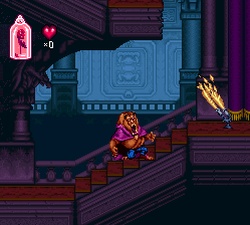
On SNES, Beauty and the Beast is something you feel in your hands: take control of the Beast and every move gains heft, every step carries momentum. Jumps aren’t about height but about the instant — let go a split second earlier than your gut says to line your arc with a swaying chandelier or a sketchy ledge. The attack is a broad paw swing with tight reach, no extra fireworks, and that’s why it lands: clean, honest impact. A couple of screens in, it clicks — this isn’t a blitz-through, but a careful Disney-flavored platformer where every burst is measured and impulse gets you tossed into a cell or into the jaws of a wolf pack.
Combat and rhythm
The Beast fights nose-to-nose. This isn’t a ranged game: you need to close in, catch the timing, take a half-step back from a counter, then slip back in to punish. Regular enemies are quick and irritating in different ways. Wolves fake a lull, then lunge with a snarl; bats drop from the rafters; suits of armor wake in corridor corners and telegraph big, sweeping blows. You have to read them: learn the patterns, spot the window, push the hit, then move again. The flow becomes a string of micro-duels on each screen — tiny encounters lasting a few seconds where the path to the next platform opens with a victorious paw swipe.
The trick is simple: don’t rush. The game nudges you into a step–pause–burst tempo. You start listening — the hollow echo of an empty hall, the scrape of a foot on polished floors, the crunch of a landing in snow. That audio metronome steadies the nervy sections, and your fingers find a comfortable control rhythm. When you lock into it, Disney’s Beauty and the Beast stops being “just a movie tie-in” and turns into a clear, fair arcade platformer where success is all about precision and spacing.
Stages and hazards
The snowy forest greets you with predatory silence. Branches spring, drifts pull you down, and the first real exam is the wolves. They attack in volleys, and you learn to cut your strike into their dash, shaving the timing right at ground level. Then the castle — corridors where ledges crumble underfoot, chandeliers swing like pendulums, and creaky floors are ready to give way. Up on the high walkways, crosswinds try to blow you off narrow beams. You tighten your stride, read the gust, jump on “one-two,” and exhale only when you hit safe ground. It’s platforming woven with atmosphere: the visuals aren’t just pretty — they’re mechanics. Ice in the woods means slide and a long braking arc. Rain on the roof means slick stones and a short stability window after you land.
Hazards are always readable. A falling rock casts a shadow and gives an audio cue. A swinging chandelier sets a beat you have to sync your jump to. Armor that wakes up? First the feather on the helm trembles, then the whole suit stirs. For a classic SNES platformer, there’s no cheap-shot energy here: it’s teachable, like learning music — in bars, with repetition, and a careful, steady ramp in difficulty.
It’s also about space. The castle “breathes” with hidden pockets: a small alcove behind a column holds a lifesaver; under a beam, a skinny crosspiece leads to a couple of bonuses. They rarely scream for attention, but when your intuition pings, a sidestep often pays off. The rose isn’t just a symbol: its petals are your health bar, and watching it bloom back after finding a core pickup or a recovery flask is a small joy, warm as the library fireplace.
Boss fights and a character check
Bosses play like set pieces. The forest pack fights as a single foe — swat one attack, prep for the next from the opposite side. And of course the climax: the castle rooftops in a thunderstorm. Wind drives rain into your face, lightning rips the sky, and there’s Gaston, charging headlong, trying to corner you, bullying you with space. Here the gameplay fuses with the drama: you’re not just dealing damage, you’re managing position, baiting him onto danger zones and refusing to be pinned to the edge. Every trade feels like a tiny scene from the film: step, lunge, duck under, and your paw answers with that heavy, precise swing. Once you read his patterns — the game, sometimes mislabeled on old cartridges and rental shelves, turns into a timing clinic, and the final chord lands loud and deserved.
The difficulty “holds its line.” It’s not about brutal traps — it’s about attention. Checkpoints are placed to keep the flow intact: you mess up, hop back a bit, fix the mistake, and push through cleaner. It’s satisfying to re-route a run: here you shaved time across chandeliers, there you stopped arguing with the wind and waited for a good window, elsewhere you found one more petal and clutched it out on the last hit. It all adds up to a fair-feeling arcade vibe — no salt, no pointless time sink.
Little things that stick
Controlling the Beast is a pleasure on its own. There’s momentum you feel in your fingers: short run-up, short hop; long run-up, generous carry. A buttoned strike won’t ragdoll enemies, but it ends the exchange if you’re at the right spacing. Sometimes you want to “play bolder”: crash in, throw two quick paw slaps, and clear a chunk in one breath — and when it works, that inner arcade string twangs. In those moments, Disney’s Beauty and the Beast gives a wink: yep, that’s viable if your hands are warmed up.
The atmosphere never drops. The wolf-haunted forest, the empty halls where footsteps echo, balconies with snow in the distance — it all sells a journey, not just a level list. Within that journey, genre staples click: secrets, small side paths, readable bosses, a tidy difficulty curve. Exactly what you want from a Beauty and the Beast platformer: you feel the film in your skin, not just your eyes. Especially when you lock into the beat and move without stopping, yanking yourself back from the brink again and again — and landing exactly where the next jump is already waiting.
And yes, call it Beauty and the Beast, Disney’s Beauty and the Beast, or even “Красавица и Чудовище” on Super Nintendo — it’s that game where the “Belle game” quietly becomes a game about you: your timing, your patience, your grit. When the little pieces click, you remember why it’s so easy to return years later: your fingers know where to brake, where to push, how to slip under that chandelier, stick the landing, and grin to yourself: it worked.